


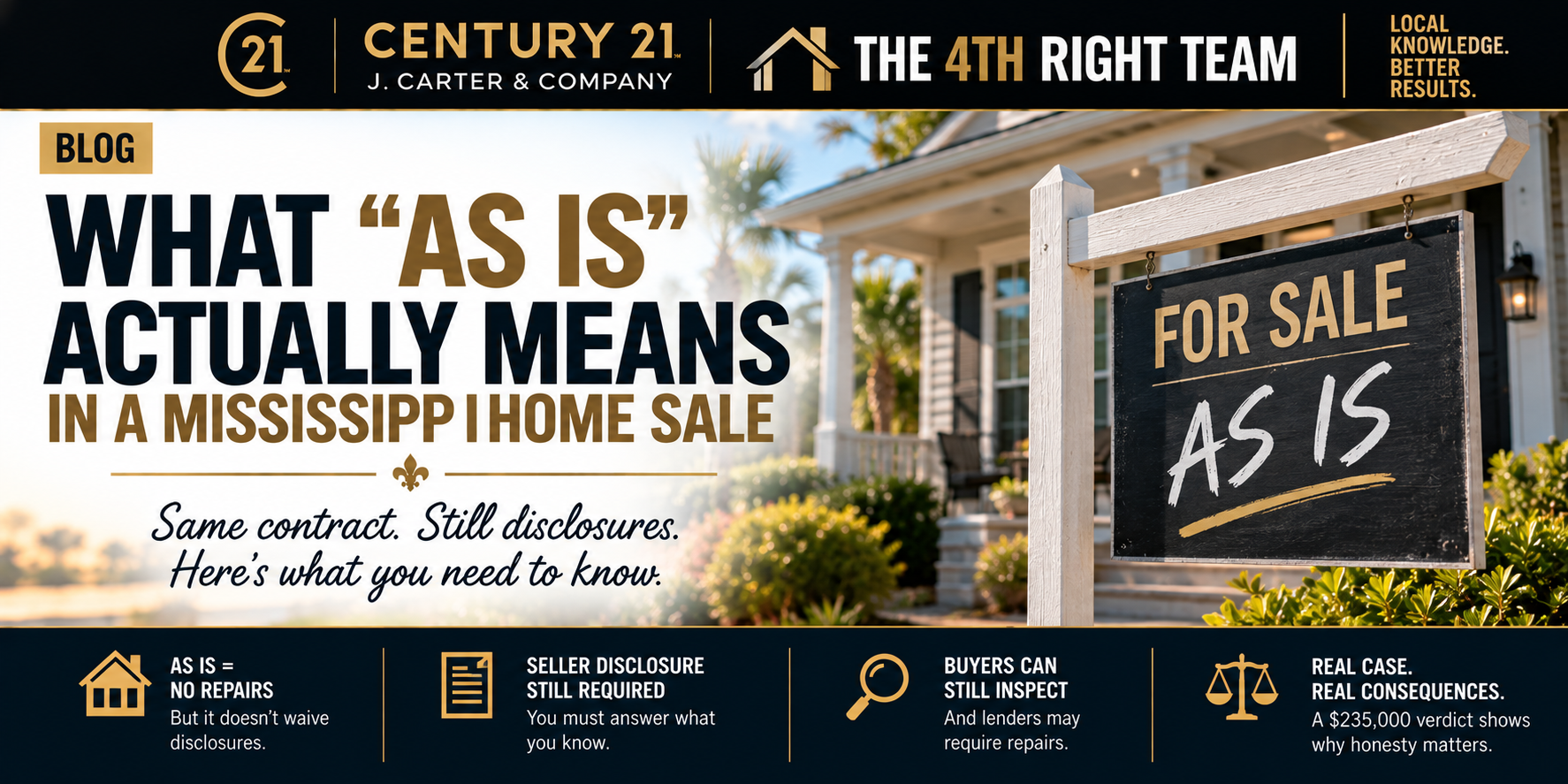
Blog > What "As Is" Actually Means in a Mississippi Home Sale
By Randy Richardson, Broker Associate, The 4th Right Team
Quick Answer: In a Mississippi home sale, "as is" means the seller isn't agreeing to make repairs or give credits for the home's condition. It doesn't change what the seller has to disclose. Sellers still have to answer the state's Property Condition Disclosure Statement honestly on anything they personally know, and in 2020 the Mississippi Court of Appeals upheld a $235,000 verdict against sellers who left known defects off the form despite an as-is contract. Buyers can still inspect, and a lender can still require repairs before an FHA or VA loan closes. Only specific sales set by state law, like estates, foreclosures and court-ordered sales, are excused from the disclosure form.
What does "as is" mean in a Mississippi real estate contract?
It's a promise about repairs, not about information. The seller is saying, "I'm selling the house in the shape it's in, and I'm not fixing anything."
That's a legitimate way to sell. It tells buyers the price already reflects the condition and there won't be a repair list after inspection.
What it doesn't do is let the seller stay quiet about what they know. The exact wording also varies by contract form, so read the as-is language in the one you're signing with your agent before you count on it.
Does selling as is get me out of the seller disclosure?
No. In Mississippi, most sellers of a home with one to four units have to give the buyer the state's Property Condition Disclosure Statement, and an as-is contract doesn't change that.
I put this question to a local closing attorney I work with. His answer was simple. The duty is to answer the form's questions honestly and in good faith about things you personally know. Selling as is doesn't change that duty. And the biggest trouble he sees is sellers leaving off something they actually knew about.
The form asks about the roof, structure, water, termites and past storm or flood damage. I walk through those questions in my post on what Mississippi sellers must disclose. Repaired problems count too, which matters for a lot of pre-Katrina homes that have been patched more than once.
What happened when Mississippi sellers tried the as-is defense?
They lost. In Lewis v. Rula, decided by the Mississippi Court of Appeals in 2020, sellers in Madison County had paid a contractor to repair a wall and its connection to the roof several times. When they sold, they left the wall, leak and roof sections of the disclosure form blank. The contract said the buyers accepted the home in its existing condition.
After closing, the buyers found the problems, replaced the wall and sued. A jury awarded them $235,000, and the Court of Appeals upheld it. The court said leaving questions blank isn't the same as not misrepresenting, especially when the sellers knew about the defects.
Here's the part sellers should actually take away. According to a Land Title Association of Mississippi summary of the case, Mississippi courts have let an as-is clause protect a seller when the buyer was told about the problem and bought anyway. So as-is works best when it's paired with honest disclosure. Tell the buyer what you know, write it down, and then sell it as is.
State law does say that if a seller skips part of the form, the buyer is on notice to ask about it. Lewis shows that's no safe harbor when you knew. I'm not an attorney, so if you're weighing how to answer a question on the form, ask one before you sign.
Which Mississippi sellers don't have to fill out the disclosure?
The exceptions are narrow and written into state law. Mississippi Code section 89-1-501 excludes sales ordered by a court, including probate sales. It excludes foreclosures and sales by a lender that took the home back. It excludes sales by a fiduciary handling a decedent's estate, a guardianship, a conservatorship or a trust. It also covers a few family transfers, like one co-owner selling to another.
The closing attorney explained why. These sellers aren't expected to have personal knowledge of the house. A bank that took a home back has never lived in it.
If you inherited a house, don't assume you're exempt. Whether your sale falls under the estate exception depends on how it's being handled, so ask your attorney.
What can still change an as-is deal after the contract is signed?
Three things. The first is the buyer's inspection. An as-is buyer can still inspect and, depending on the contract terms, still walk away during the inspection period. As-is means you won't fix what they find. It doesn't mean they can't look.
The second is insurance. On the Coast, a buyer who can't get a policy can't close. An older roof is the usual problem, and carriers can refuse to write it no matter what the contract says. That's why I tell buyers to get an insurance quote before they write an offer. Sellers should know their roof age before they list.
The third is the lender. An FHA appraiser has to note any repairs needed for the home to meet HUD's minimum property requirements, and the loan can be made subject to those repairs. VA loans have their own minimum property requirements, which matters on a Coast full of VA loan buyers. When that happens, somebody has to make the repair, the buyer has to change loans, or the deal ends. A low appraisal works the same way. As-is doesn't stop any of it.
When does selling as is make sense on the Mississippi Gulf Coast?
When the cost and hassle of repairs is more than the price difference you'd get for making them. That's often true for estates, homes with storm damage the owner can't take on, and sellers who need to move fast.
The key is pricing it for its condition from day one. As-is homes priced like updated homes sit, and overpriced listings sit longer here than people expect. Expect as-is buyers to price in every repair.
Also know that as-is doesn't have to mean no negotiation. A buyer can still ask for a price cut after inspection, and in a market where buyers have room to negotiate, they often will. You can say no. But run the numbers on a seller net sheet before you do, and compare it against a small repair credit that keeps the deal together.
By the Numbers
Homes covered by Mississippi's seller disclosure law: one to four dwelling units
Verdict upheld in Lewis v. Rula (Miss. Ct. App. 2020) despite an as-is contract: $235,000
Main groups excluded from the disclosure form: court-ordered sales, foreclosures and lender-owned sales, and fiduciaries such as estates and trusts
What as-is changes: the seller's repair obligation
What as-is doesn't change: the disclosure duty, the buyer's inspection, insurance or the lender's appraisal
The Bottom Line
As-is is about repairs, not honesty. It's a smart way to sell the right house, as long as you disclose what you know and price for the condition. Do both, and as-is protects you. Skip the disclosure, and it won't.
If you're thinking about selling as is, start with a home value evaluation so you know what the house is worth in its current shape. Then I'll show you how I list and market an as-is home so it sells to the right buyer.
Frequently Asked Questions
Does "as is" mean I don't have to disclose problems in Mississippi?
No. As-is means you won't make repairs. You still have to answer the Property Condition Disclosure Statement honestly on anything you personally know, unless your sale falls under one of the exceptions in state law.
Can a buyer back out of an as-is contract in Mississippi?
Often, yes, depending on the contract. Buyers can usually still inspect and terminate within the inspection period. Insurance and lender requirements can also end a deal.
Who is exempt from Mississippi's seller disclosure form?
State law excludes court-ordered sales, foreclosures and sales by lenders that took a home back, and sales by fiduciaries handling an estate, guardianship, conservatorship or trust, along with a few family transfers.
Can an FHA or VA loan close on an as-is house?
Yes, if the home meets the loan's minimum property requirements. If the appraiser flags required repairs, they have to be handled before closing or the buyer needs a different loan.
Sources
Disclosure exclusions and who the law covers: Mississippi Code section 89-1-501 (Justia)
Buyer on notice when a disclosure is incomplete: Mississippi Code section 89-1-503 (Justia)
Lewis v. Rula, 293 So. 3d 317 (Miss. Ct. App. 2020), and cases enforcing as-is when buyers were told: Land Title Association of Mississippi, Failure to Disclose Defects in House was Misrepresentation Despite As Is Clause
FHA appraisals made subject to required repairs: HUD, FHA appraisal conditions and minimum property requirements
Seller disclosure duty and as-is: a local closing attorney, written answers, September 2026
[ADD SOURCE: VA minimum property requirements for appraisals]
About the Author
Randy Richardson is a Broker Associate and Team Leader of The 4th Right Team at CENTURY 21 J. Carter & Company. He serves buyers and sellers across the Mississippi Gulf Coast.
Randy Richardson | Broker Associate
The 4th Right Team | Century 21 J. Carter & Company
📞 Office: (228) 731-3881 | Cell: (228) 547-9999
📧 realtorrandyrichardson@gmail.com
🌐 www.The4thRightTeam.com
Looking to SELL or BUY? I know a GUY!