


Blog > Buying a Beach or Bay Condo as a Second Home on the Mississippi Gulf Coast
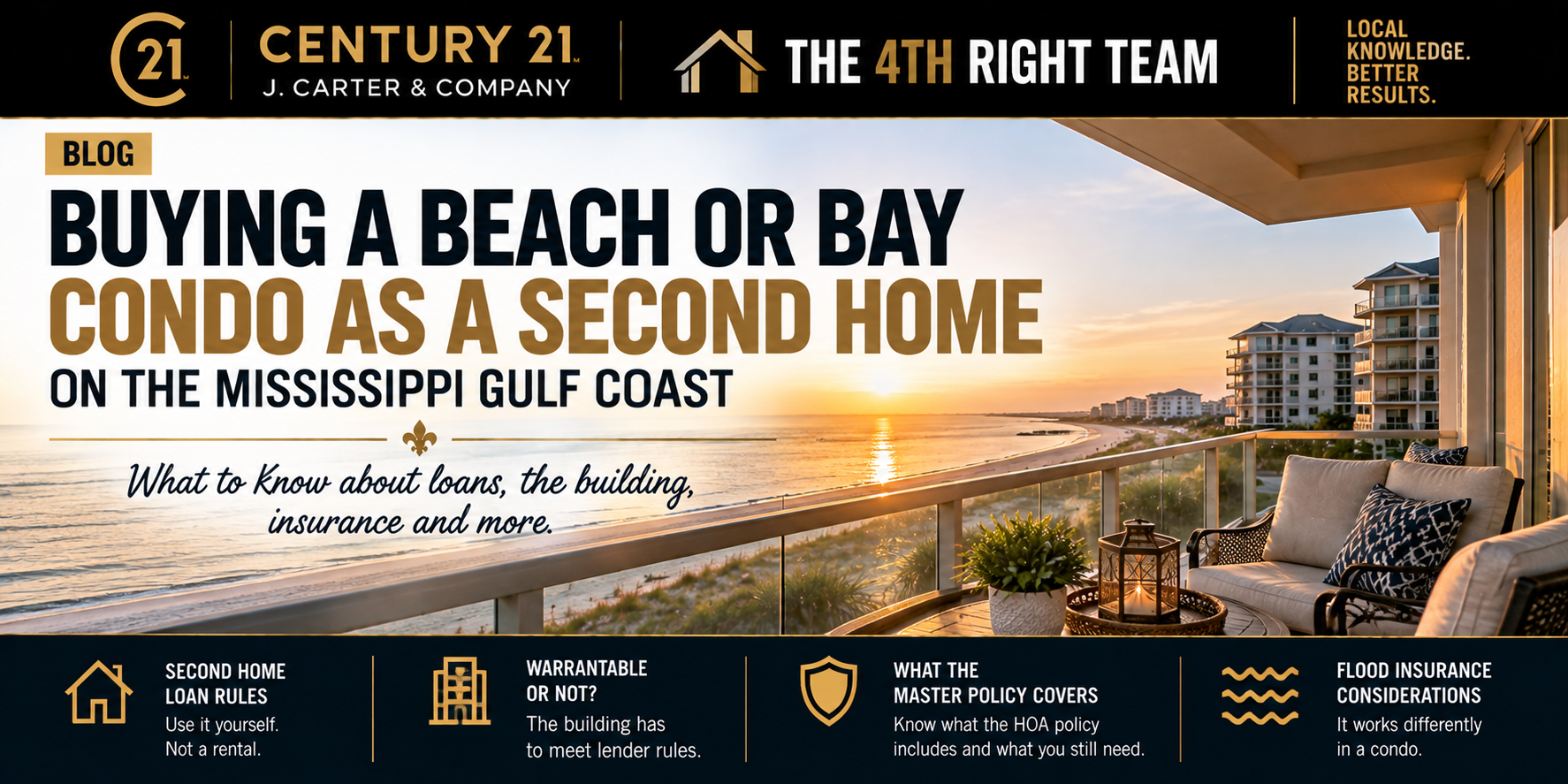
Buying a Beach or Bay Condo as a Second Home on the Mississippi Gulf Coast
by
By Randy Richardson, Broker Associate, The 4th Right Team
Quick Answer: A beach or bay condo on the Mississippi Gulf Coast can be a great second home, but three things decide whether it works: the loan, the building and the insurance. To finance it as a second home, you have to use it yourself part of the year, and it can't be run like a rental or hotel. The building itself has to pass the lender's condo project review, and towers that operate like hotels or need critical repairs can fail it. On insurance, the association's master policy covers some of the building and you cover the rest, and the bylaws decide where that line falls. Read the association documents before you make an offer, not after.
Can I finance a Coast condo as a second home?
Yes, if you're really using it as one. Fannie Mae's rules say a second home has to be occupied by you for some portion of the year, be suitable for year-round use, and stay under your exclusive control. It can't be subject to an agreement that gives a management company control over who stays there, and it can't be a rental property or a timeshare.
You can still rent it some. Fannie Mae allows rental income on a second home as long as the lender doesn't use that income to qualify you. But if the plan is to rent it most of the year and visit once, that's an investment property, and it's financed differently. Be straight with your lender about how you'll use it. Misstating occupancy on a loan application is a serious problem, not a technicality.
Second-home loans generally need more cash than a primary residence, so talk through down payment options early.
What makes a Gulf Coast condo building non-warrantable?
A condo loan is really two approvals. You get approved, and the building gets approved. When a project doesn't meet Fannie Mae or Freddie Mac standards, people call it non-warrantable, and it narrows your loan options fast.
Fannie Mae lists the project types it won't finance. The ones that matter most on the beach are buildings that operate like a hotel, motel or resort, buildings that need critical repairs or have significant deferred maintenance, and projects where more than 15% of units are 60 or more days behind on their dues. After the 2021 condo collapse in Florida, Fannie Mae and Freddie Mac tightened the rules on critical repairs and special assessments.
A non-warrantable building doesn't mean you can't buy. It usually means a bigger down payment, a higher rate from a portfolio lender, or cash. It also shrinks your pool of buyers when you sell. Ask your lender to check the project before you write an offer.
What does a condo master policy cover on the Coast?
Less than most buyers assume, and it changes from one building to the next.
Kelsey Carlson, CISR Elite, a Personal Lines Risk Advisor at Lemon Mohler Insurance, told me unit owners routinely misjudge what they're responsible for. "Interior only" can mean everything from the studs in for one association, and only the upgrades since original construction for another. The bylaws decide. That's why the best move is having your insurance agent read the bylaws and the master policy together.
Your own condo policy, often called an HO-6, covers your share of the unit, your belongings and your liability. Ask about loss assessment coverage too. On the Coast, a master policy may carry a large wind deductible. If a storm hits, the association can pass that cost to owners as a special assessment, and loss assessment coverage helps pay your share. Ask how the building handles wind coverage. Ask too whether it's written through the wind pool.
If the building comes with a boat slip, ask about that separately. Kelsey said a standard homeowners policy excludes structures over water, and slips and piers are a common gap on bay front property.
Do I need my own flood insurance in a beach condo?
Often, yes, and it works differently than in a house. The association can buy an NFIP Residential Condominium Building Association Policy on the building. You can buy your own NFIP policy on your unit, but FEMA caps combined building benefits for a single unit at $250,000 across both policies, and it only pays for the same damage once.
Your belongings aren't covered by the association's policy. FEMA encourages unit owners to buy their own contents coverage. A unit owner policy can also help with a loss assessment if the association's policy was underinsured and a coinsurance penalty applies.
A ground-floor unit and a sixth-floor unit in the same tower have very different flood exposure for contents. Your agent can tell you what makes sense for yours. Get an insurance quote before you write an offer. The master policy share in your dues plus your own policies is part of your real payment.
Can I rent out my Gulf Coast condo when I'm not using it?
Maybe, and you have to check two rulebooks. The association's documents may set minimum lease terms, cap how many units can be rented, or require registration. The city may have its own short-term rental rules, and those differ from Biloxi to Ocean Springs to Bay St. Louis.
Then check it against your loan. A rental program run by the building, where a manager controls occupancy, can conflict with second-home financing and can push the project toward hotel status in a lender's review. If rental income is part of your plan, make sure the building, the city and the loan all agree before you sign.
What should I read before I make an offer on a Coast condo?
Ask for the association's documents up front. That means the bylaws and rules, the current budget, the reserve fund balance and any reserve study, recent board minutes, the master insurance declarations, and any pending litigation or planned special assessments. Minutes are where you'll see a roof replacement or a seawall repair being discussed before it turns into a bill.
Also check for one-time fees at closing. When I broke down a real condo closing, the buyer paid a $1,000 one-time association contribution on top of reimbursing prepaid dues. Those are written in the documents too.
By the Numbers
Fannie Mae second home rule: you occupy it part of the year, with exclusive control
Rental income on a second home: allowed, but not used to qualify
Dues delinquency that can make a project ineligible: more than 15% of units 60 or more days late
NFIP combined building cap for one condo unit: $250,000
One-time association contribution in a real 2026 Coast condo closing: $1,000
The Bottom Line
A Coast condo second home comes down to the building as much as the unit. Get the loan type right, have your lender check the project, and have your insurance agent read the bylaws and master policy together before you're under contract. Do that, and you'll know your real cost and your exit before you fall for the view.
If you're starting to look, my buyer's guide walks through the steps. You can also check current prices and inventory in the Gulf Coast market snapshot.
Frequently Asked Questions
Can I rent out a condo I bought as a second home?
Some, under Fannie Mae's rules, as long as you occupy it part of the year, keep control of it, and the lender doesn't use the rental income to qualify you. The association and the city may add their own rental rules.
What is a non-warrantable condo?
It's a condo in a building that doesn't meet Fannie Mae or Freddie Mac project standards, for example a building that operates like a hotel, needs critical repairs, or has too many owners behind on dues. It usually means a bigger down payment, a higher rate, or cash.
Does the condo association's insurance cover my unit?
Partly. The master policy covers what the bylaws assign to the association. You insure the rest, plus your belongings and liability, usually with an HO-6 policy.
How much flood insurance can a condo unit get through the NFIP?
FEMA caps combined building benefits for a single unit at $250,000 across the association's policy and the unit owner's policy. Contents need their own coverage.
Sources
Second home requirements and rental income: Fannie Mae Selling Guide B2-1.1-01, Occupancy Types
Ineligible condo projects: Fannie Mae Selling Guide B4-2.1-03, Ineligible Projects
Condotel and dues delinquency reasons: Fannie Mae Condo Project Manager ineligibility reasons
Critical repairs and special assessments update: Fannie Mae Selling Guide Announcement SEL-2023-06
$250,000 combined unit cap: FEMA, Standard Flood Insurance Policy commentary (June 2025)
Unit owner contents coverage: FEMA NFIP Summary of Coverage, Residential Condominium Buildings (May 2024)
Loss assessment and coinsurance: FEMA Emergency Management Institute, IS-1114 RCBAP course
Unit owner responsibilities and over-water structures: Kelsey Carlson, CISR Elite, Personal Lines Risk Advisor, Lemon Mohler Insurance, written answers, September 2026
One-time association contribution: a spring 2026 Mississippi Gulf Coast condo settlement statement, shared with identifying details removed
About the Author
Randy Richardson is a Broker Associate and Team Leader of The 4th Right Team at CENTURY 21 J. Carter & Company. He serves buyers and sellers across the Mississippi Gulf Coast.
Randy Richardson | Broker Associate
The 4th Right Team | Century 21 J. Carter & Company
📞 Office: (228) 731-3881 | Cell: (228) 547-9999
📧 realtorrandyrichardson@gmail.com
🌐 www.The4thRightTeam.com
Looking to SELL or BUY? I know a GUY!